
Read Lowndes County Property Tax Records
Two offices share the work behind Lowndes County property records. The Board of Assessors builds the annual real and personal property digest. It keeps parcel characteristics, ownership, values, and exemptions current. The Tax Commissioner then converts that assessment data into bills. That office collects payments, and it manages delinquency and tax sales. Keep the parcel number and tax year constant throughout.
| Field | What It Shows | Where |
|---|---|---|
| Fair market value | The assessor's full-value estimate for tax administration | Board of Assessors / qPublic |
| Assessed value | Normally 40 percent of fair market value for Georgia real property | Board of Assessors / qPublic |
| Land and improvements | Components supporting the parcel's value | Parcel card |
| Exemptions | Relief fields that can reduce taxable value | Assessor record |
| Bill and status | Tax due, payment route, balance, or delinquency | Tax Commissioner |
Georgia's standard is 40 percent of fair market value. Qualified agricultural property may follow special rules. Treat last-sale data as its own field, never as the assessor's current value or the amount due on a Lowndes County tax bill.
Find the Lowndes County Assessment Card
Start with the official qPublic entry for Lowndes County. Search by owner, address, or parcel ID. The result card can carry PPIN or PARID, owner, mailing and physical addresses, acreage, class code, taxing district, assessed value, exemptions, legal text, deed book and page, and recent sale fields. Sales update monthly. qPublic notes that its data comes from the last certified tax roll.
| Search field | Best use | Verify |
|---|---|---|
| Address | One known parcel | Physical address, not merely owner mailing address |
| Owner | All parcels under one displayed name | Initials, entity suffix, and same-name matches |
| Parcel ID | Exact tax record | Spaces, leading zeroes, and old parcel number |
Ownership refreshes monthly, near the first. A just-recorded deed may take time to appear. The delay only affects the owner label, so the duty to match the right parcel and tax year stays with you.
Look Up a Lowndes County Tax Bill
Use the Lowndes County Tax Commissioner site for any tax bill. It issues bills, tracks balances, and takes payments. Card or vendor fees can apply online. The office also serves counter, mail, and drive-through customers, which helps when the portal will not return a record or a receipt needs clarification.
- Find the parcel in qPublic and copy its parcel ID and owner spelling.
- Open the Tax Commissioner search, select the matching account, and confirm the year.
- Compare assessed value and exemptions against the assessor card.
- Read the current balance, payment status, and any delinquency or FiFa notice.
- Assessed value
- The value to which the tax calculation is applied under Georgia rules.
- Mill rate
- A levy expressed per thousand dollars of taxable value.
- Homestead exemption
- Qualified relief applied through the assessor process.
- FiFa
- A tax execution associated with unpaid property tax.
Check Lowndes County Due Dates and Payment Routes
The general Lowndes County bill comes due November 15. The county tax information page describes online, mail, and office payment. Dates and instructions can shift with each year's notice. Read the tax year printed on the record. Confirm the live instructions at the Tax Commissioner site before sending funds.

Pay through the government-linked route and check any fees shown at checkout rather than trusting an unaffiliated payment page for Lowndes County taxes.
Review Lowndes County Exemption Fields
qPublic can display exemption fields. The Board of Assessors decides assessment and exemption matters in Lowndes County. April 1 is the standard homestead application date in Georgia guidance. A blank or coded field on a parcel card settles nothing. It does not establish eligibility, filing status, or why an application was accepted or denied.
The Board of Assessors at 302 N Patterson Street in Valdosta, reached at 229-671-2540, can provide the current form. It can also supply the proof it requires and the status of any parcel. Keep a copy of whatever was filed. Then compare the next assessment notice and tax bill to confirm the exemption was applied as expected.
Appeal a Lowndes County Assessment
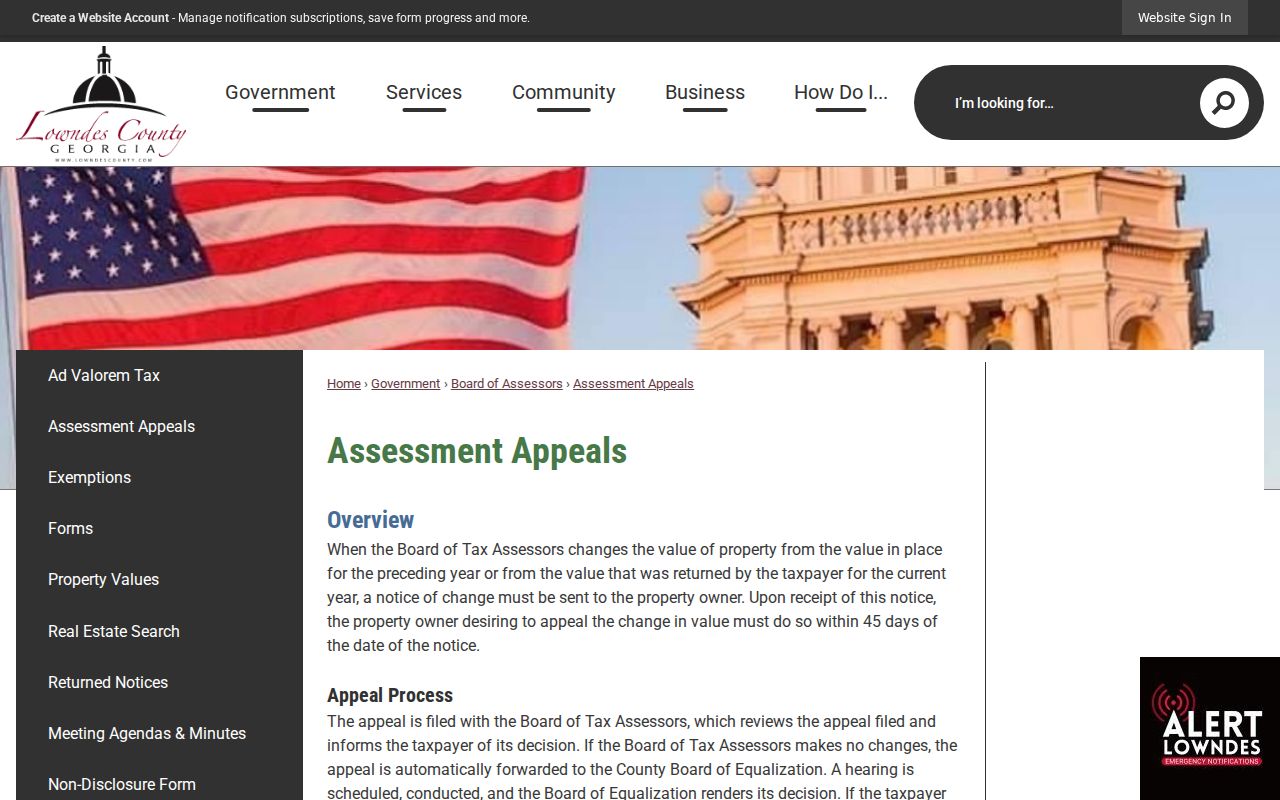
File within 45 days of the assessment notice. Lowndes County accepts value, uniformity, taxability, and denial of exemption as grounds. Several routes exist. Depending on the case, an appeal can go to the Board of Equalization, arbitration, or a hearing officer, with Superior Court review available where the governing procedure allows it.
Appeal window. File with the Lowndes County Board of Assessors within 45 days of the notice date and keep proof of timely delivery.
The county's assessment appeals page lays out the paths and grounds. Evidence matters. Bring the notice, parcel card, photographs, comparable-property records, a recent appraisal, a survey, or documents showing a factual error. Any of these strengthens a Lowndes County appeal.
Read the current notice itself for the controlling deadline and submission address.
Trace Lowndes County Delinquency and Tax Sales
Unpaid tax rarely sits still. A balance can grow into interest, penalties, a FiFa, and eventually a tax sale. Lowndes County holds sales on the first Tuesday at the courthouse steps, with legal notices published first. A sale notice is a dated procedural record. It is not proof the property actually sold.
County pages describe penalties differently. One shows five percent every 120 days, up to a 20 percent cap, while another charges one percent monthly, ten after 90 days. Do not guess which applies. Rely on the current bill, the dated notice, and Tax Commissioner confirmation for the parcel and tax year at issue.
Place Lowndes County Property Tax Records in Digest Context
The county's five-year digest table tracks total real and personal net value. It climbed from roughly $3.533 billion in 2020 to $5.848 billion in 2025. A countywide trend like that says nothing about whether one parcel was valued fairly. It does explain why comparisons work best within a single roll category and notice date. For value fields without the bill mechanics, the Lowndes County property value guide breaks them down.
A county notice dated August 12, 2026 covered the 2026 property-tax digest. Rely on current notices and assessor meeting materials for the active cycle. An older bill, roll, digest attachment, or payment record may be missing online. Request it from the Tax Commissioner or Board of Assessors by parcel and year. The Board of Commissioners Clerk also handles administrative attachments. Reach that office at bocrecords@lowndescounty.com, 229-671-2400, or 327 N Ashley Street, third floor. Under the Georgia Open Records Act, the custodian usually provides access within three business days. Otherwise the custodian sends a written timetable. The first 15 minutes of search and retrieval are free. Reasonable search, copying, and supervision costs may apply after that.
Describe the exact record you want rather than asking staff to build a new tax analysis. Give the parcel ID, situs address, owner name as shown, tax year, and item type. Item types include a bill, receipt, digest page, appeal notice, exemption filing, or delinquency record. A narrow request is easier to route. It also lowers the odds of receiving a different year's account.